
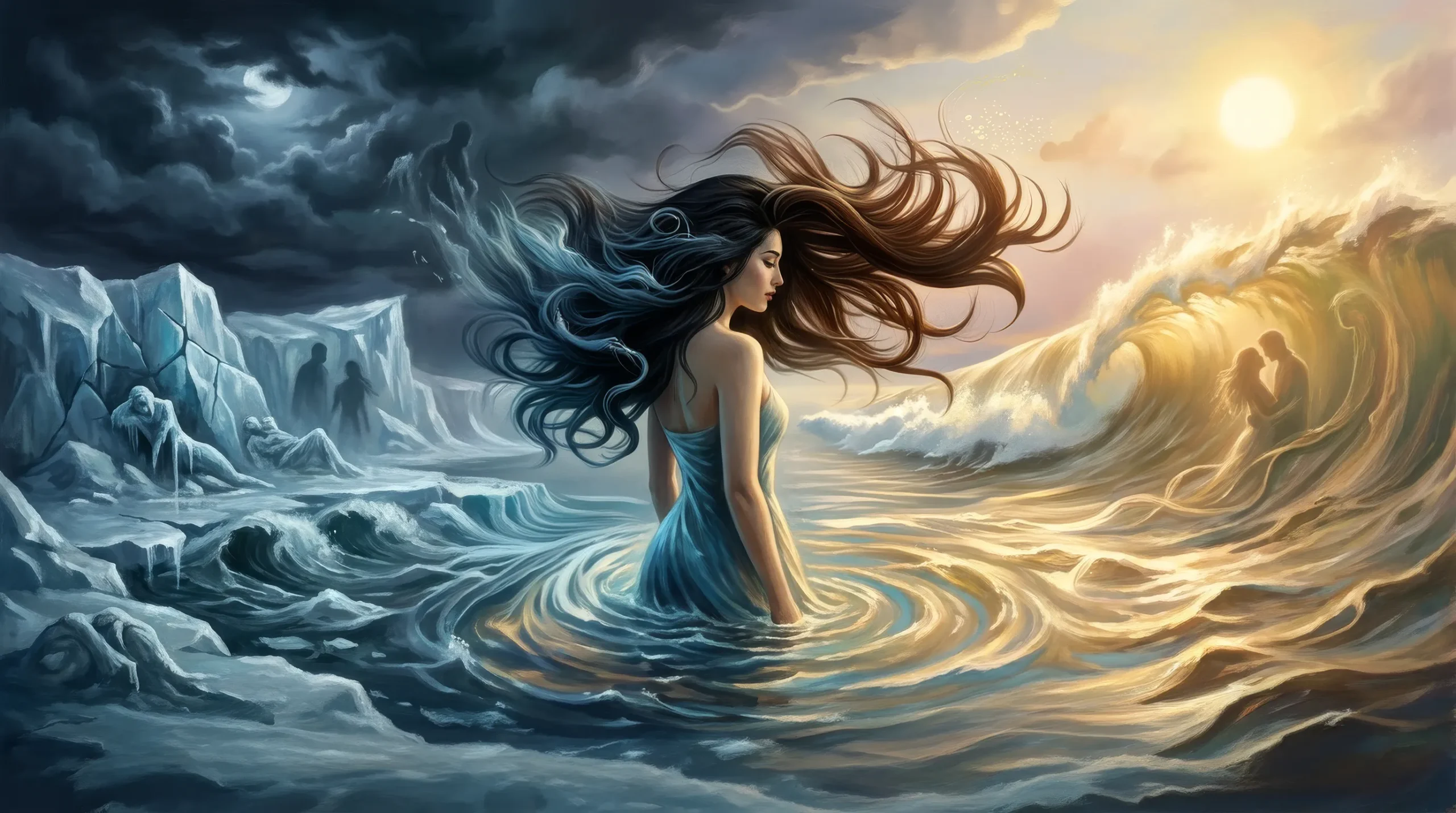

This is not a guide for everyone. It is the map I’ve drawn from inside my own tides — a way to recognize the freeze, the thaw, the collapse, so I don’t mistake my own movement for destruction.
But I also know I’m not the only water creature in this world. There are others who feel the field the way I do — quietly, intensely, alone. If you are one of them, maybe these words will help you recognize your own weather, and know you’re not the only one who moves this way.
There are days when the tide inside me slows and freezes. When the world goes white and brittle, and every thought crystallizes into a single, aching point behind my ribs. When the field around me — the one I pretend I don’t feel — grows loud enough to drown out my own pulse.
On those days, I become a creature of ice. Numb. Suspended. Held in a moment too sharp to swallow, too bright to look at, too heavy to carry.
People think water breaks when it freezes. They don’t understand — you can’t break water. You can only shatter ice. And even then, it melts and coalesces again.
The first crack is always internal — a hairline fracture running through the center of me, a warning that the emotional field has become too disorganized to navigate. A signal that something in the system is misaligned, unmet, unspoken.
The storm begins beneath the surface. The dysregulation trapped by the freeze. Slowly, I feel it rise from the belly first — that ancient heat, that molten ache. It climbs my spine like a creature trying to escape its own skin. It fills my chest with pressure, with longing, with the unbearable weight of being a body that feels too much and not enough at the same time.
And then — the collapse.
People fear collapse. I embrace it. Collapse is the thaw.
It’s the moment the ice gives way, the moment the body says, I cannot hold this shape any longer. The moment the scream — the barbaric yawp — tears through the frozen surface and lets the trapped water rush out.
I shake. I cry. I let the terrified part of me speak in her raw, unfiltered tongue. I let her tell me everything she’s been holding: the loneliness, the longing, the fear of being forgotten, the ache of being unseen, the grief of loving someone who feels both near and impossibly far.
I don’t silence her. I don’t soothe her. I don’t correct her.
I let her melt.
Because collapse is not the end of the tide. Collapse is the turning point.
When the wave has spent itself — when the body is emptied, when the tears have carved their riverbeds, when the pressure has broken open — something shifts. The emotional tides move again, past the noise, returning to the gravity that pulls them.
It’s subtle at first: a loosening in the chest, a softening in the jaw, a breath that reaches deeper than the one before.
Then comes that unmistakable sensation — fluid rushing through the system, like a glass of cold water on a hot day. A shift so quiet and complete it feels like the whole body exhales.
Music returns to me like a shoreline. I can’t touch it when I’m frozen — it only amplifies the ache. But when I’m fluid again, music becomes a current I can ride, a reminder that movement is possible, that nothing stays stuck forever.
This is what a settled field feels like for me: not stillness, but flow. Not silence, but rhythm. Not calm, but coherence.
My emotions become liquid again — not less intense, but less trapped. They move through me instead of circling inside me. They speak in currents instead of knives.
And in that movement, meaning begins to surface. Not forced. Not willed. Not interpreted prematurely.
Meaning rises the way bubbles rise from the ocean floor — slowly, naturally, inevitably — once the water is warm enough to let them go.
I’ve learned not to fear the freeze. I’ve learned not to fear collapse. I’ve learned not to fear the ache that rises like a tide determined to swallow me whole.
My emotions have never lied to me. Only my interpretations have.
I don’t think first. I feel. I flow. I thaw. I return.
And every time I break open, I remember:
I am not fragile. I am tidal. And tides always come back.
