

…With a Monotropic Relational Field –
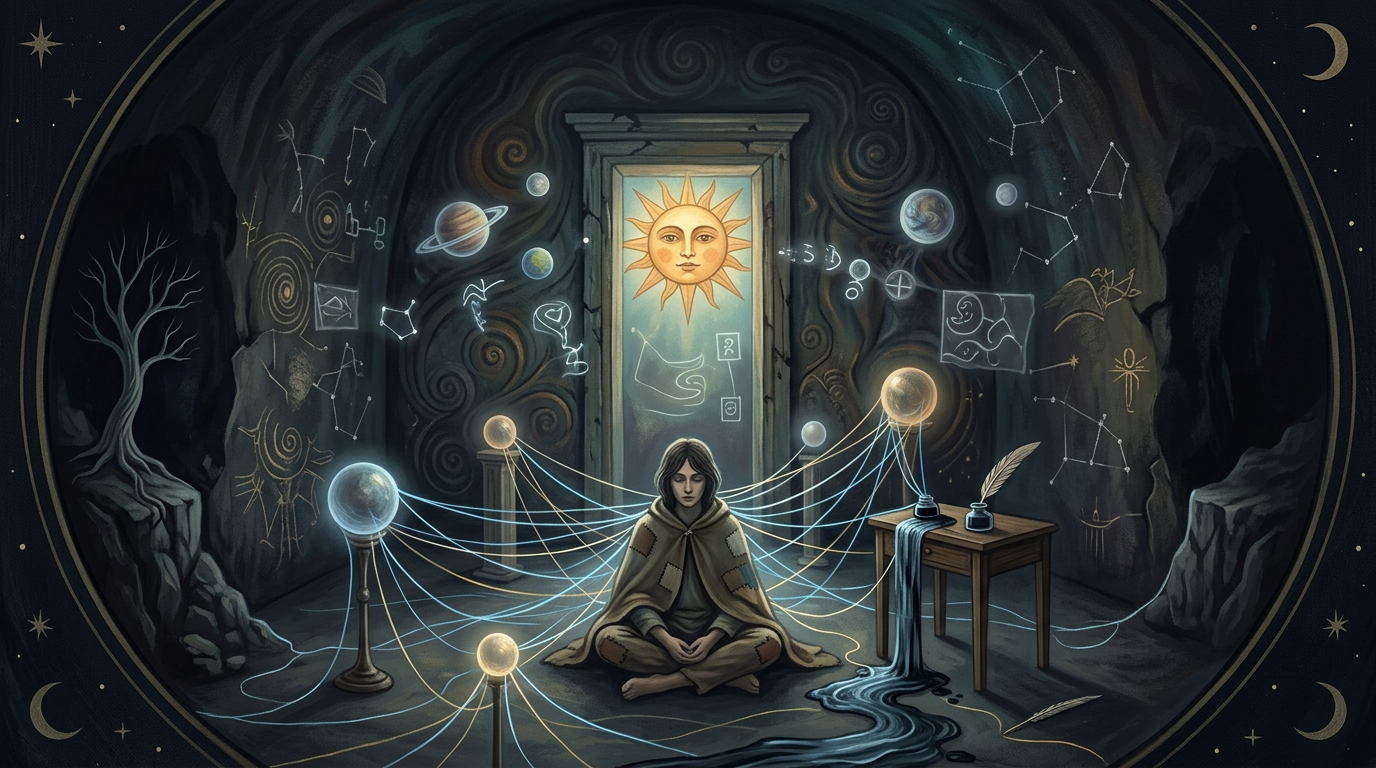
I grew up learning to live inside my own mind long before I learned to live in the world. It wasn’t a choice. It was the only place that stayed still long enough for me to breathe. The adults around me shifted like weather — warm one moment, cold the next, unpredictable in all the ways that matter to a child. So I built a room inside myself where the air didn’t change without warning. A place where I could think, rehearse, imagine, and prepare.
People assume imagination is an escape. Mine was never that. It was a laboratory. A training ground. A place where I could run every possible relational scenario — love, connection, loyalty to heartbreak, abandonment, betrayal, — to see if I could survive it, if I could integrate it. I would break my own heart on purpose, just to see if I could put it back together. I didn’t know it then, but I was building resilience in the only way available to me. Sometimes this was to my own detriment, particularly when I would get stuck on a scenario that was untrue.
My attachment has always been singular. I don’t scatter. I don’t divide myself across many people. My heart orients toward one person at a time, like a compass that refuses to pretend north is anywhere else. When I find someone who matches my frequency — someone whose presence feels like recognition rather than performance — I attach with a depth that startles people who live their lives on the surface. I’ve learned not to apologize for that. It’s simply how I’m built.
My ex-husband used to call it “running scenarios.” He did it too, though for different reasons. His childhood left wounds that shaped everything around intimacy for him, and he needed to rehearse safety before he could risk reaching for it. I understood that instinct. I’d been doing it my whole life. The difference was that my inner world wasn’t just a rehearsal for connection — it was the place where my identity grew when the outside world wasn’t safe enough to hold it, which was most of the time for me.
There were years when I didn’t need that room as much. During my doctorate, raising kids, drowning in deadlines and responsibilities, I didn’t have the time or the emotional bandwidth to sink into the deep interior spaces where I used to live. And for a while, I didn’t need to. I wasn’t afraid my husband would leave me. I wasn’t running heartbreak simulations. My identity had a place to grow in the real world. It was then that I lent my imagination to my clients in therapy.
In my professional life, this inner world became one of my greatest clinical tools. I didn’t just listen to my clients — I stepped into their internal landscapes with them. After sessions, my mind would run quiet relational “scenarios” the way it always has, not out of worry but out of curiosity and care. I would explore the emotional barriers they couldn’t yet name, the patterns that held them back, the unspoken dynamics shaping their choices. Often, those insights helped people see themselves differently — not because I was telling them who they were, but because I could feel the shape of their world from the inside.
The challenge, especially early on, was timing. I had spent my childhood speaking truths before people were ready to hear them, and it cost me relationships with family who found my clarity overwhelming. Graduate school taught me how to refine that instinct — how to hold truth gently, how to offer it when it could be received. Case conceptualization wasn’t just a skill for me; it was a place where my mind felt at home, a synthesis of empathy, imagination, and precision that made me love the work of being a psychologist.
Just as I was entering my clinical internship, (the last hurdle to obtaining my PsyD), the betrayal came — not physical, but intimate in all the ways that matter — something in me snapped back to the old architecture. I recognized it instantly. The late‑night gaming, the imagined relationships, the quiet ache of building a world where my feelings had somewhere to land. It wasn’t regression. It was survival. It was my system doing what it has always done: creating a relational field inside myself when the external one collapses.
I’ve always been monotropic in my attachments. One person. One bond. One emotional home at a time. When that home is lost, my identity doesn’t disappear — it goes into a kind of holding pattern, suspended between what was and what might be. And until the world becomes safe again, I return to the inner room I built as a child. Not to hide, but to keep myself intact.
People misunderstand this about me. They think I’m fragile because I love deeply, or that I’m obsessive because I don’t “move on” the way they do. But the truth is simpler: my identity grows through depth, not multiplicity. I don’t replace people. I don’t dilute my attachments. I don’t scatter my heart to soften the blow. When I tried, it caused me unnecessary suffering. It is why I orient, fully and honestly, toward the one who feels like home.
And when that home is gone, I don’t collapse. I rebuild, by returning to the inner world that has always held me…. until the outer one catches up.